
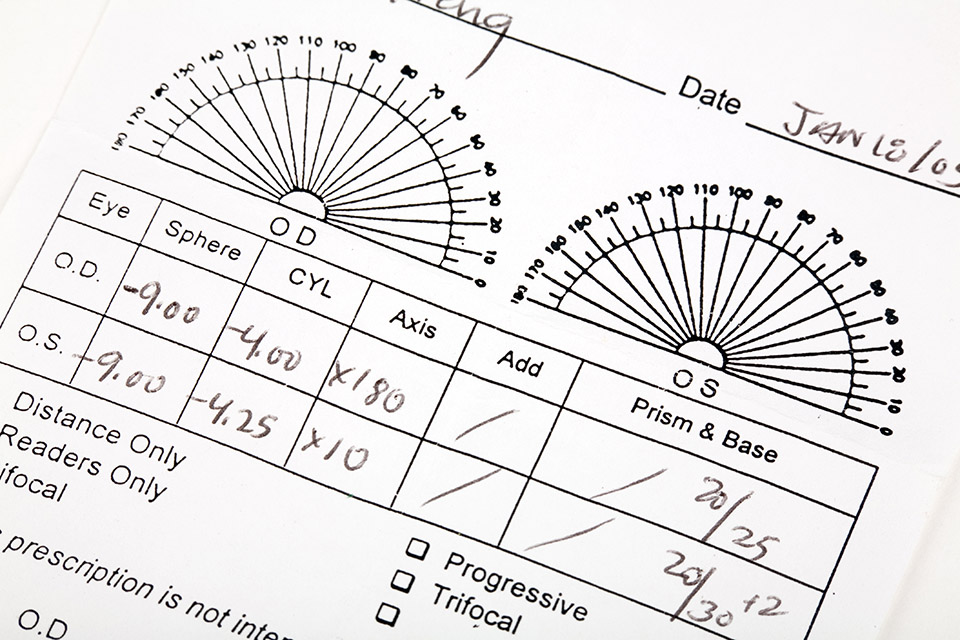
Almost everyone who wears glasses has been handed a prescription slip and walked out of the office with only a vague sense of what it says. The abbreviations are clinical, the numbers seem arbitrary, and the format varies enough between practices that even experienced glasses wearers find themselves confused when switching providers or shopping online. Here’s what it all actually means.
The Basic Structure of an Eyeglass Prescription
A standard eyeglass prescription is divided into two eyes: OD (oculus dexter, or right eye) and OS (oculus sinister, or left eye). Some prescriptions add OU, which refers to both eyes together. The Latin origins are a quirk of medical tradition that has never been updated, and they trip people up more than any other part of the document.
Within each eye’s row, you’ll typically see three core values: sphere (SPH), cylinder (CYL), and axis. These three numbers work together to describe your full refractive correction — they can’t be read in isolation.
What Sphere, Cylinder, and Axis Each Mean
Sphere is the most straightforward number. It measures the degree of nearsightedness or farsightedness in your eye, expressed in diopters. A negative number means you’re nearsighted — you see clearly up close but struggle at distance. A positive number means you’re farsighted. The further from zero, the stronger the correction needed.
Cylinder measures the degree of astigmatism, which is an irregularity in the curvature of the cornea or lens that causes blurred or distorted vision at multiple distances. Not everyone has a CYL value — if the field is blank or reads 0, you have no significant astigmatism in that eye. Like sphere, a negative number indicates myopic astigmatism; positive indicates hyperopic.
Axis only appears when there is a cylinder value. It describes the orientation of the astigmatism correction, expressed in degrees from 1 to 180. Without the axis, the cylinder correction has no reference point and cannot be applied. The two numbers are inseparable.
For anyone who wants to go deeper on what these values mean for their specific prescription and how they translate into lens selection, a plain-language guide to reading your eyeglass prescription can bridge the gap between what your optometrist measures and what ends up in your frames.
Add Power, Prism, and Base: The Less Common Values
If you’re looking at a bifocal or progressive prescription, you’ll likely see an additional field: ADD, or addition power. This is the extra magnification added to the lower portion of the lens to support near vision. It’s always a positive number, and it’s the same for both eyes in the vast majority of cases.
Prism and base appear less frequently — only when there’s a need to correct a binocular vision problem, such as a misalignment between the eyes. Prism shifts the apparent position of images to help both eyes work together comfortably. Base indicates the direction of the prism. Most people will never see these values on their prescription.
What Your Prescription Doesn’t Tell You
Here’s the part that surprises most people: an eyeglass prescription is a measurement of your refractive error, not a specification for your lenses. The numbers tell you what correction you need — they don’t tell you anything about lens material, index, coating, or design. Those decisions happen at the point of purchase, and they matter significantly for visual quality, durability, and comfort.
A high prescription in a low-index lens will be noticeably thick and heavy. A progressive prescription paired with the wrong lens design for your frame geometry will produce a narrow usable corridor and eye fatigue. An anti-reflective coating that isn’t properly matched to your lens material degrades faster and performs worse. None of this information lives in your prescription — it has to come from an informed conversation with an optician.
Prescription portability is a genuine right — you’re entitled to a copy of your prescription after any exam, and you can take it anywhere. But understanding what the numbers mean, and what they don’t, puts you in a much stronger position to make good decisions with whoever fills it.